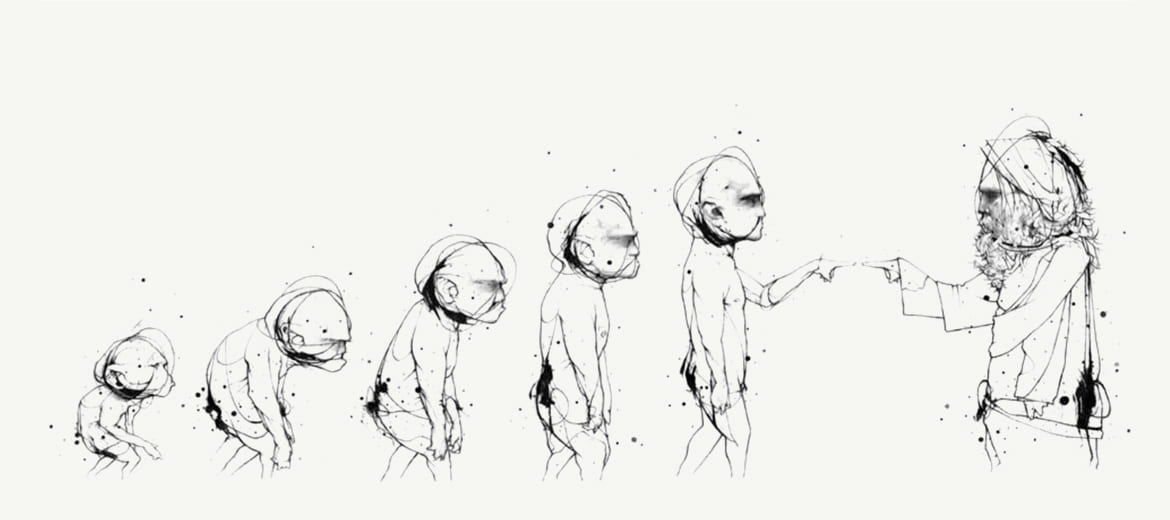
How Evolution Theory Reshaped Religions
Abstract
When Charles Darwin introduced his theory of evolution in On the Origin of Species (1859), he unknowingly ignited one of the most profound challenges religions had ever faced. For centuries, sacred texts had offered clear, purposeful accounts of how life began, the stories that placed humans at the center of a divinely created world. Evolution, by contrast, told of slow, undirected change, of common ancestry shared with all living things. To many, this was not just a scientific idea, but it was a theological earthquake. This paper explores how religious belief has responded, resisted, and adapted in the age of evolution. It traces key moments of tension from the fiery debates of the 19th century to courtroom dramas like the Scopes Trial, while also examining quieter shifts in theology, doctrine, and public opinion. Drawing on examples from Christianity, Islam, Hinduism, and Buddhism, the study shows that religious responses have been far from monolithic. Some traditions hardened their opposition, while others embraced evolution as a tool in the hands of a Creator. The paper also considers a more recent development: the use of evolutionary theory to explain the origins of religion itself. Far from undermining faith, such studies offer new insights into why belief persists and how it helps communities flourish. Ultimately, this exploration reveals that the relationship between science and religion is not a zero-sum struggle but an evolving conversation. Evolution did not destroy religion; it forced it to grow, to ask deeper questions, and, in many cases, to reach for a broader understanding of the divine.
Downloads
References
Ayala, Francisco J., Darwin’s Gift to Science and Religion (Joseph Henry Press, 2007)
Bharati, Swami Agehananda, The Tantric Tradition (Doubleday, 1970)
Boyer, Pascal, Religion Explained : The Evolutionary Origins of Religious Thought (Basic books, 2001)
Brenan, Megan, ‘In U.S., Belief in Creationist View of Humans at New Low’, 2021 retrieved from https://news.gallup.com/poll/210956/belief-creationist-view-humans-new-low.aspx 3 Feb 2025.
Dennet, Daniel Clement, Breaking the Spell : Religion as a Natural Phenomenon (Penguin Books, 2007)
Desmond, Adrian, and James Moore, Darwin: The Life of a Tormented Evolutionist (W. W. Norton & Company., 1991)
Dixon, Thomas, Science and Religion : A Very Short Introduction (Oxford University Press Inc., 2022)
Guessoum, Nidhal, Islam’s Quantum Question : Reconciling Muslim Tradition and Modern Science (I.B. Tauris, 2011)
Larson, Edward John, Summer for the Gods: The Scopes Trial and America’s Continuing Debate Over Science and Religion (Harvard University Press, 1998)
Livingstone, David N., Darwin’s Forgotten Defenders : The Encounter between Evangelical Theology and Evolutionary Thought (Edinburgh, 1987)
Lopez, Donald S., Buddhism and Science : A Guide for the Perplexed, Sustainability (Switzerland) (The University of Chicago Press, 2019), XI
Pope Francis, ‘Address to the Pontifical Academy of Sciences’, 2014 retrieved from: https://www.vatican.va 3 Feb 2025
Pope John Paul II, ‘Message to the Pontifical Academy of Sciences’, 1996 retrieved from: https://www.vatican.va 3 Feb 2025
Pope Pius XII, Humani Generis, 1950 retrieved from: https://www.vatican. va 3 Feb 2025
Ruse, Michael, Can a Darwinian Be a Christian? The Relationship between Science and Religion (Cambridge University Press, 2000).
S.Collins, Francis, The Language of God: A Scientist Presents Evidence for Belief (Free Press, 2006), doi:10.5840/pc20079116.
Wilson, David Sloan, Darwin’s Cathedral : Evolution, Religion, and the Nature of Society (University of Chicago Press, 2022).