Archives
-
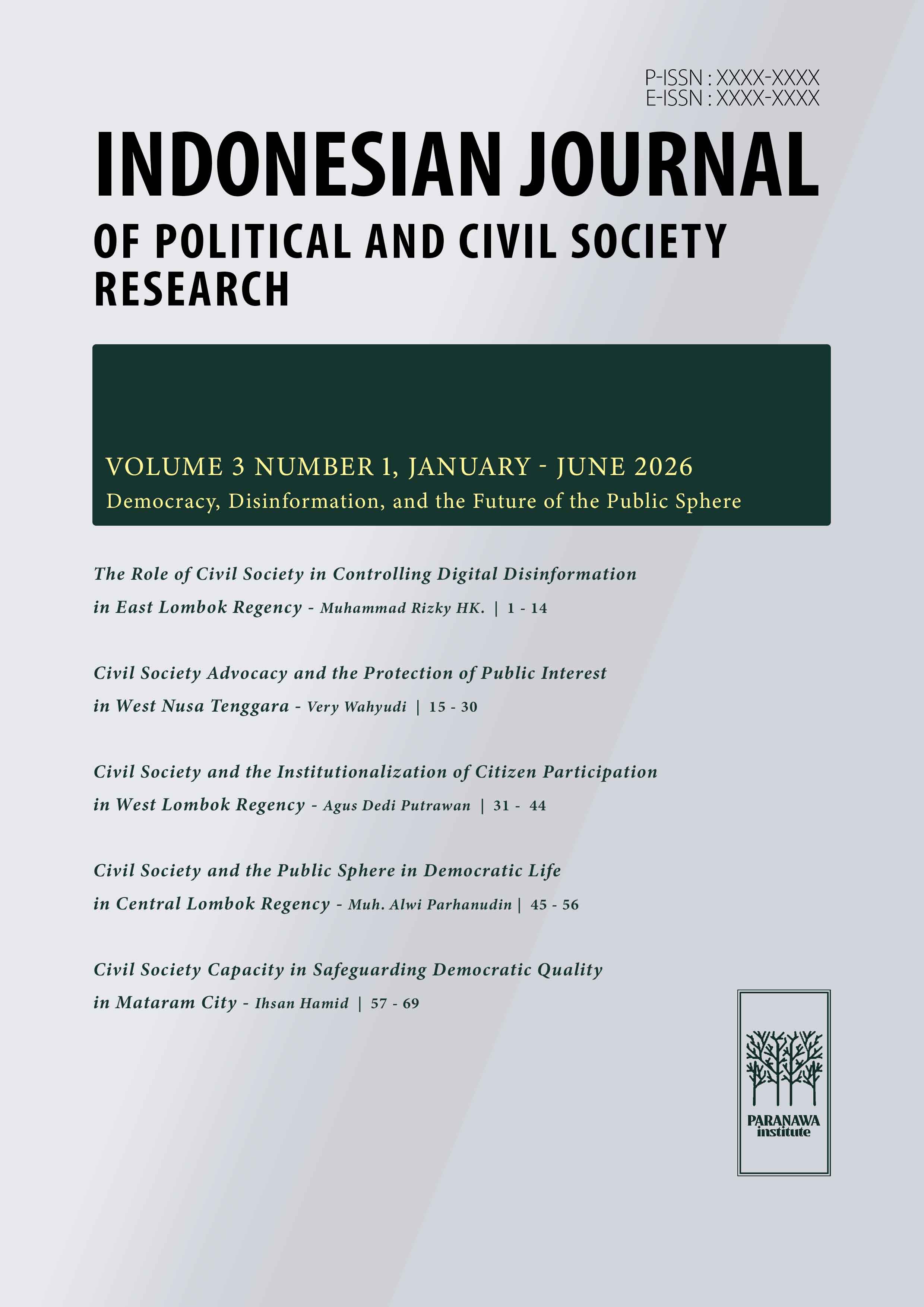 Democracy, Disinformation, and the Future of the Public Sphere
Vol. 3 No. 1 (2026)
This theme begins from the reality that contemporary democracy is moving within a rapidly changing communication landscape. The public sphere, once imagined as an arena for the exchange of ideas, rational consideration, and the formation of a shared will, is now under pressure from massive, fast-moving, fragmented, and often difficult-to-verify flows of information. Disinformation no longer appears as a marginal disturbance. It has become an active part of struggles over influence, the shaping of opinion, the mobilization of identity, and the management of political perception.
The development of digital technology has expanded citizen participation, but it has also created wide opportunities for information manipulation, narrative fabrication, social polarization, and the weakening of public trust in democratic institutions. Under such conditions, the public sphere undergoes a shift in character. It no longer functions fully as a space of deliberation, but is often driven into a field of competition for attention, the production of sentiment, and struggles over legitimacy. As a result, the quality of public conversation, the health of democracy, and the capacity of citizens to take political positions reflectively all face increasing pressure.
Through this theme, the journal encourages studies that examine the relationship between democracy, digital media, disinformation, algorithms, epistemic authority, citizen participation, civil society movements, and the transformation of the public sphere in local, national, and global contexts. The theme also opens space for inquiries into identity politics, the ethics of public communication, digital propaganda, media literacy, platform regulation, and the new challenges faced by civil society in safeguarding the integrity of democratic life.
This issue is expected to serve as an academic space for developing a deeper understanding of how democracy is being tested by changes in the informational order, and of how the future of the public sphere may still be conceived as a field of freedom, responsibility, and the shaping of a more dignified common life.
Published: 2026-04-22Download PDF -
Islam, Science, and the Spirit of Social Movements: Reconstructing Faith and Reason in the Public SphereVol. 2 No. 1 (2025)
This issue explores the dynamic interplay between Islam, scientific thought, and the emergence of socially-engaged movements in contemporary societies. At a time when modern science is often seen either in conflict with or detached from religious traditions, this volume highlights how Islamic worldviews have not only responded to scientific developments but have also generated new forms of civil activism rooted in the pursuit of justice, knowledge, and moral transformation.
Drawing from interdisciplinary perspectives, ranging from political theology and sociology of science to Islamic studies and civil society theory, the articles in this issue demonstrate how faith and reason, far from being opposing forces, have historically coexisted and continue to inspire collective mobilizations. Whether addressing environmental ethics, educational reform, feminist reinterpretations, or critiques of technocracy, the contributions show how Islam and science intersect as intellectual and spiritual energies within the lifeblood of civil movements.
By critically engaging with both classical Islamic epistemologies and modern scientific paradigms, this issue invites readers to reconsider the boundaries of religious authority, the role of knowledge in activism, and the potential for renewed public spheres in Muslim-majority and plural societies alike.
Published: 2025-06-27 -
 Social and political movements of Pondok Pesantren in West Nusa Tenggara
Vol. 1 No. 1 (2024)
With pride and admiration, we present to you The Indonesian Journal of Political and Civil Society Research, a dedicated intellectual platform aimed at exploring the profound dimensions of social and political movements within the context of Pondok Pesantren. As spiritual and educational foundations, pondok pesantren play an invaluable role in shaping the identity, values, and worldviews of communities across various corners of the globe, especially in Indonesia.
Pondok pesantren have long been integral to Indonesia's socio-political landscape. These institutions, deeply rooted in religious teachings and traditional values, have not only served as centers for religious education but have also played significant roles in shaping social and political movements across the archipelago.
One of the primary contributions of pesantren to social and political movements in Indonesia lies in their ability to produce a cadre of educated individuals with strong religious convictions and a sense of social responsibility. Students of pesantren undergo rigorous religious studies, which often include discussions on ethical behavior, social justice, and community service. This educational environment fosters a deep commitment to social welfare and encourages students to actively engage in efforts to address societal issues.
Moreover, pesantren have historically served as centers of resistance against colonial rule and authoritarian regimes. During Indonesia's struggle for independence, many pesantren leaders and students actively participated in the fight against colonial powers, advocating for self-determination and national sovereignty. Similarly, during periods of political repression, pesantren often provided refuge for dissidents and intellectuals, offering a safe haven for those seeking to promote democratic ideals and human rights.
Furthermore, pesantren have been instrumental in promoting grassroots activism and community empowerment. Through their extensive networks and influence at the local level, pesantren leaders have been able to mobilize communities to address various social and political issues, such as poverty alleviation, environmental conservation, and interfaith dialogue. By empowering ordinary citizens to take charge of their own destinies, pesantren have helped to democratize Indonesia's civil society and foster a culture of active citizenship.
In addition to their grassroots activism, pesantren have also exerted influence at the national level through their involvement in political parties and civil society organizations. Many prominent political figures in Indonesia, including former presidents and government ministers, have emerged from pesantren backgrounds, bringing with them a unique perspective shaped by Islamic teachings and values. Moreover, pesantren-affiliated organizations, such as Nahdlatul Ulama (NU), Muhammadiyah, and Nahdlatul Wathan have played key roles in shaping public policy and advocating for the rights of marginalized groups.
In conclusion, the contribution of pesantren to social and political movements in Indonesia cannot be overstated. These institutions have not only produced generations of religious scholars and leaders but have also served as catalysts for change, promoting social justice, democracy, and human rights. As Indonesia continues to navigate its path towards development and democracy, pesantren are likely to remain influential actors in shaping the country's socio-political landscape for years to come.
Paranawa Institute Journal invites you to delve into analyses, reflections, and thought-provoking discussions on how Islamic boarding schools serve as primary stages for social and political movements. From in-depth studies on the roles of Islamic scholars (kyai) in decision-making processes to the dynamic relationships between Pondok Pesantren and political powers, we present a diverse array of articles exploring various facets of this complex phenomenon.
Through this journal, we hope to inspire deeper dialogue, foster broader understanding, and encourage critical reflections on the roles of pondok pesantren within contemporary social and political dynamics. We also aspire for this journal to serve as a valuable reference for academics, practitioners, and policymakers interested in this field.
Our heartfelt thanks go to the authors who have contributed their quality articles and to the editorial team and reviewers who worked diligently to present this journal to you. Without our collective efforts, this achievement would not have been possible.
Enjoy the reading, may Paranawa Journal provide valuable insights and inspire meaningful actions toward the advancement of inclusive and sustainable social and political developments.
Published: 2024-06-05 -
Politics and Civil Society in Contemporary IndonesiaVol. 2 No. 2 (2025)
This issue examines politics and civil society as a dynamic field of contestation, cooperation, and institutional negotiation. It invites scholarly contributions that explore how civic actors, organizations, and informal networks shape political life; how the state responds through regulation, co-optation, and partnership; and how public participation is reconfigured amid changing social, economic, and technological conditions.
Rather than treating “civil society” as a fixed moral category, the issue approaches it as a lived arena where values, interests, identities, and power relations are articulated and tested. Articles may engage with classical and contemporary political theory, empirical case studies, comparative perspectives, or interdisciplinary approaches that connect political institutions with civic practices.
Topics of interest include, but are not limited to: civic engagement and democratic consolidation; social movements and collective action; political participation and representation; state–society relations; public policy advocacy; media, digital activism, and civic discourse; political parties and community organizations; local politics and grassroots governance; pluralism, religion, and civic citizenship; and the ethics of civic action in contexts of polarization and inequality.
By bringing together conceptual clarity and grounded analysis, this issue aims to deepen understanding of how politics and civil society mutually constitute one another and how civic energies can both expand and constrain democratic possibilities.
Published: 2025-12-20 -
Political Discourse: Ontology, Power, and SocietyVol. 1 No. 2 (2024)
This issue explores the multifaceted dimensions of political discourse, focusing on the intersection of ontology, power, and society. By examining the foundational questions of being and existence within political structures, this collection of articles delves into the philosophical underpinnings that shape power dynamics and societal organization. Contributors analyze how ontological perspectives influence the construction of authority, governance, and public engagement in various socio-political contexts.
The issue also highlights critical debates surrounding the role of ideology, identity, and culture in shaping political realities. It addresses contemporary challenges in political theory and practice, offering insights into the evolving relationship between individual agency, institutional power, and collective aspirations. With a multidisciplinary approach, this edition seeks to provide a deeper understanding of how ontology informs the dynamics of power and its implications for modern society.
Designed for scholars, practitioners, and students in political science, philosophy, sociology, and related fields, this issue aims to advance critical conversations at the intersection of theory and praxis in political studies.
Published: 2024-12-20