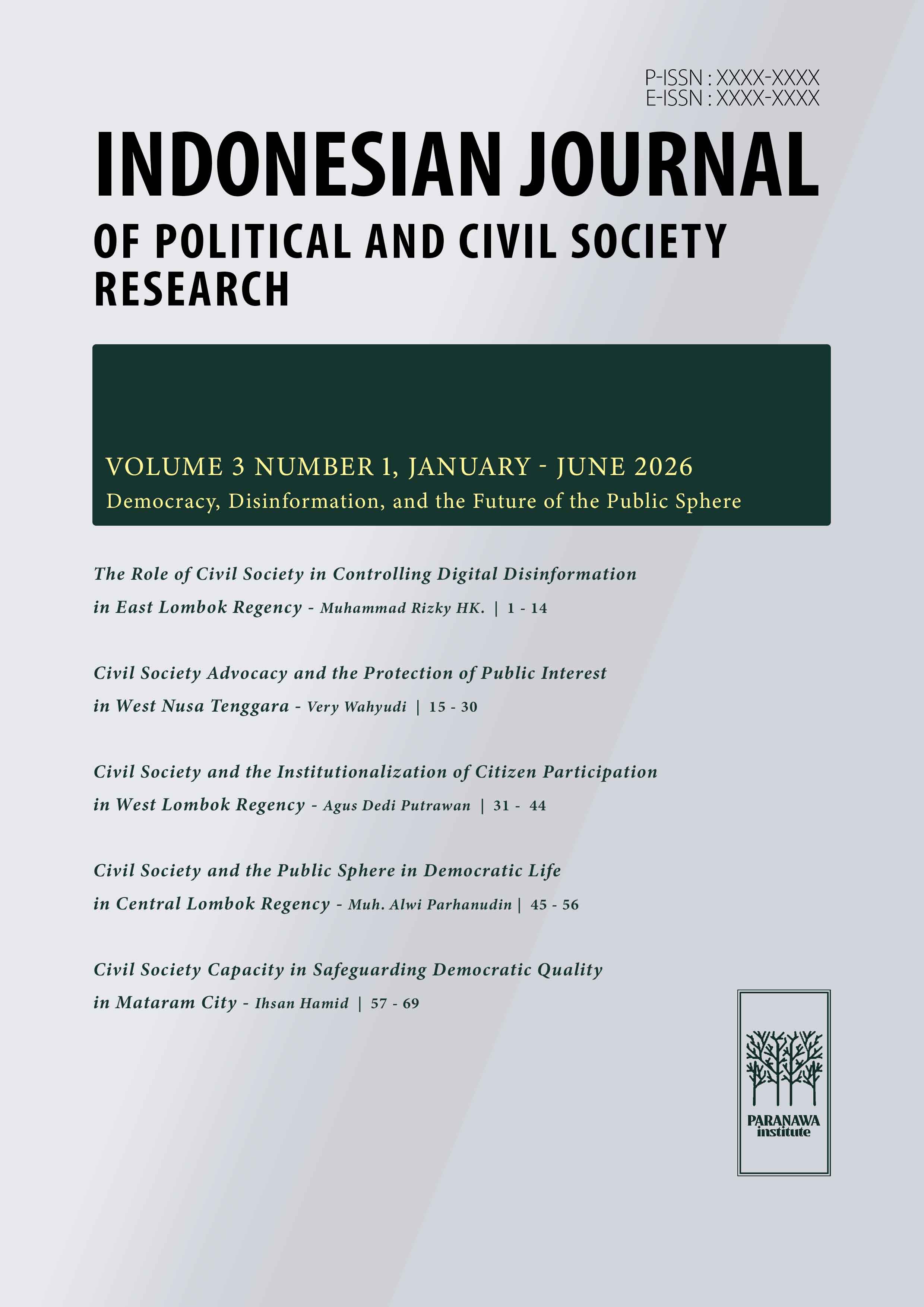
Civil Society Advocacy and The Protection of Public Interest in West Nusa Tenggara
Abstract
This article examines how civil society advocacy contributes to the protection of public interest in West Nusa Tenggara. The central problem addressed here is that the public interest rarely protects itself through formal constitutional recognition alone. In decentralized democratic settings, public interest requires intermediaries able to interpret grievances, aggregate demands, monitor institutions, circulate public information, and transform dispersed social vulnerability into actionable claims. The article employs a qualitative design based on literature review and document analysis. The sources include civil society theory, advocacy scholarship, Indonesian decentralization studies, public-service accountability literature, official regional documents, reports on migrant-worker protection, disaster-governance materials, and publicly available data relevant to West Nusa Tenggara. The findings show that civil society advocacy in West Nusa Tenggara is most effective when it operates through five interconnected functions: issue translation, associational representation, institutional monitoring, cross-sector coalition building, and public-interest framing. These functions are particularly important in a provincial context marked by geographic dispersion, strong village and religious networks, labor migration, recurring disaster risk, service-access inequality, and the continuing need for transparent complaint handling. The article argues that the protection of public interest in West Nusa Tenggara depends less on episodic protest alone than on the sustained ability of civil society to build durable advocacy infrastructures linking citizens, media, local institutions, and policy arenas. The paper concludes that democratic deepening in the province requires stronger civic research capacity, wider complaint-based accountability, more inclusive representation of vulnerable groups, and institutional arrangements that treat civil society not as an external disturbance but as a constitutive force in public governance.
Downloads
References
Badan Pengawas Pemilihan Umum Provinsi Nusa Tenggara Barat. “Bawaslu NTB Apreasiasi Kinerja Bawaslu Kabupaten/Kota.” June 12, 2024.
Badan Pengawas Pemilihan Umum Provinsi Nusa Tenggara Barat. “Kolaborasi Demokrasi: Bawaslu NTB Gandeng UNIZAR Perkuat Pengawasan Partisipatif.” January 27, 2026.
Badan Pusat Statistik Provinsi Nusa Tenggara Barat. Nusa Tenggara Barat Province in Figures 2025. Mataram: BPS Provinsi NTB, 2025.
Badan Pusat Statistik Provinsi Nusa Tenggara Barat. Nusa Tenggara Barat Province in Figures 2026. Mataram: BPS Provinsi NTB, 2026.
Beetham, David. Democracy and Human Rights. Cambridge: Polity Press, 1999.
Biezen, Ingrid van, and Petr Kopecký. “The State and the Associations: The Rise and Decline of Political Parties as Representative Institutions.” Party Politics 20, no. 5 (2014): 1-13.
Brown, David L. Participation and the Public Good in Civil Society. New York: Routledge, 2010.
Chambers, Simone, and Jeffrey Kopstein. “Bad Civil Society.” Political Theory 29, no. 6 (2001): 837-865.
Cohen, Jean L., and Andrew Arato. Civil Society and Political Theory. Cambridge, MA: MIT Press, 1992.
Data NTB Prov. “NTB Penyumbang PMI Terbesar ke-4 Nasional.” 2025.
Diamond, Larry. “Rethinking Civil Society: Toward Democratic Consolidation.” Journal of Democracy 5, no. 3 (1994): 4-17.
Dinas Tenaga Kerja dan Transmigrasi Provinsi Nusa Tenggara Barat. “Disnakertrans NTB Mantapkan Langkah Wujudkan Migrasi Aman melalui Penguatan Kapasitas Konselor Lokal.” October 29, 2025.
Dinas Tenaga Kerja dan Transmigrasi Provinsi Nusa Tenggara Barat. “NTB Jadi Percontohan Nasional Desa Migran Emas.” September 12, 2025.
Edwards, Michael. Civil Society. 3rd ed. Cambridge: Polity Press, 2014.
Fung, Archon. Empowered Participation: Reinventing Urban Democracy. Princeton: Princeton University Press, 2004.
Hadiz, Vedi R. Localising Power in Post-Authoritarian Indonesia: A Southeast Asia Perspective. Stanford: Stanford University Press, 2010.
Heller, Patrick. “Social Capital as Product of Class Mobilization and State Intervention.” World Development 24, no. 6 (1996): 1055-1071.
Houtzager, Peter P., and Adrian Gurza Lavalle. “Civil Society’s Claims to Political Representation in Brazil.” Studies in Comparative International Development 45, no. 1 (2010): 1-29.
Mansbridge, Jane. “Rethinking Representation.” American Political Science Review 97, no. 4 (2003): 515-528.
Manor, James. The Political Economy of Democratic Decentralization. Washington, DC: World Bank, 1999.
Migdal, Joel S. State in Society: Studying How States and Societies Transform and Constitute One Another. Cambridge: Cambridge University Press, 2001.
O’Donnell, Guillermo. “Horizontal Accountability in New Democracies.” Journal of Democracy 9, no. 3 (1998): 112-126.
Ombudsman Republik Indonesia. Laporan Tahunan 2024. Jakarta: Ombudsman RI, 2025.
Ombudsman Republik Indonesia. Laporan Triwulan II 2024. Jakarta: Ombudsman RI, 2024.
Ostrom, Elinor. Governing the Commons. Cambridge: Cambridge University Press, 1990.
Pemerintah Provinsi Nusa Tenggara Barat. “Tingkatkan Kualitas Layanan Publik, Pemprov Dorong Masyarakat Gunakan Layanan Aduan.” June 2, 2025.
Pemerintah Provinsi Nusa Tenggara Barat. Perda No. 6 Tahun 2025 tentang RPJMD NTB 2025-2029. Mataram: Pemerintah Provinsi NTB, 2025.
PPID Pemerintah Provinsi Nusa Tenggara Barat. Daftar Informasi Publik Provinsi Nusa Tenggara Barat Tahun 2025. Mataram: PPID NTB, 2025.
Przeworski, Adam. Democracy and the Limits of Self-Government. Cambridge: Cambridge University Press, 2010.
Putnam, Robert D. Making Democracy Work: Civic Traditions in Modern Italy. Princeton: Princeton University Press, 1993.
Republik Indonesia. Undang-Undang Nomor 14 Tahun 2008 tentang Keterbukaan Informasi Publik.
Republik Indonesia. Undang-Undang Nomor 25 Tahun 2009 tentang Pelayanan Publik.
Schedler, Andreas, Larry Diamond, and Marc F. Plattner, eds. The Self-Restraining State: Power and Accountability in New Democracies. Boulder, CO: Lynne Rienner, 1999.
SiAGA NTB. “Konsultasi Publik Dokumen Rencana Aksi Pembinaan dan Pengawasan Penerapan Standar Pelayanan Minimal Sub Urusan Bencana di Kabupaten/Kota Provinsi NTB 2025-2029.” May 21, 2025.
SiAGA NTB. Rencana Penanggulangan Bencana Provinsi Nusa Tenggara Barat 2025. Mataram: Pemerintah Provinsi NTB, 2025.
Suharko. “NGOs, Public Advocacy and Democratization in Indonesia.” Journal of Social and Political Studies 12, no. 2 (2008): 145-168.
Tarrow, Sidney. Power in Movement: Social Movements and Contentious Politics. 3rd ed. Cambridge: Cambridge University Press, 2011.
Tilly, Charles, and Lesley J. Wood. Social Movements 1768-2012. 3rd ed. Boulder, CO: Paradigm, 2015.
Törnquist, Olle, Stanley Adi Prasetyo, and Tatag Tatmanto, eds. Popular Politics of Representation: New Lessons from the Pioneering Projects in Indonesia, Kerala, and the Philippines. Yogyakarta: PCD Press, 2009.
United Nations Development Programme. Human Development Report 2023/2024. New York: UNDP, 2024.
Warren, Mark E. Democracy and Association. Princeton: Princeton University Press, 2001.
World Bank. World Development Report 2017: Governance and the Law. Washington, DC: World Bank, 2017.